
🛡️ Security Through Transparency and Compliance Excellence
🎯 Enterprise-grade Compliance Assessment Platform


The CIA Compliance Manager is a comprehensive application designed to help organizations assess, implement, and manage security controls across the CIA triad (Confidentiality, Integrity, and Availability). It provides detailed security assessments, cost estimation tools, business impact analysis, and technical implementation guidance to support organizations in achieving their security objectives within budget constraints.
This compliance tool demonstrates Hack23 AB's commitment to security by design and transparency, serving as both an operational platform and a live demonstration of our cybersecurity consulting expertise. Built following our Secure Development Policy and classified according to our Classification Framework, this project exemplifies security best practices through transparent implementation.
— James Pether Sörling, CEO/Founder
Experience the CIA Compliance Manager in action by testing the application here: CIA Compliance Manager Application. See how it can help you enhance your organization's security posture today!
The CIA Compliance Manager provides enterprise-grade capabilities for security assessment and compliance management:
|
Automated security level assessment across Confidentiality, Integrity, and Availability dimensions with real-time control effectiveness tracking. |
Comprehensive compliance automation for NIST 800-53, ISO 27001, GDPR, HIPAA, SOC2, PCI DSS, and EU Cyber Resilience Act (CRA). |
Integrated STRIDE threat analysis with risk quantification and attack tree visualization for comprehensive security assessment. |
|
Quantify financial, operational, reputational, and regulatory impacts using structured impact assessment methodologies from our Classification Framework. |
Calculate CAPEX and OPEX for security implementations with detailed breakdown and ROI calculator to justify security investments. |
Apply systematic data classification based on confidentiality, integrity, and availability requirements aligned with ISMS standards. |
|
Real-time visualization of security posture, compliance status, and risk metrics through intuitive interactive charts and widgets. |
Detailed technical guidance and best practices for deploying security controls across all CIA triad levels. |
Generate compliance reports and collect evidence artifacts for audit preparation and regulatory requirements. |
This platform serves security professionals and decision-makers:
- 🎯 CISOs & Security Directors - Strategic security posture management and compliance oversight
- 📋 Compliance & Risk Officers - Regulatory compliance tracking and audit preparation
- 💼 IT Managers & System Administrators - Security control implementation and operational management
- 🏗️ Security Architects & Engineers - Technical security design and architecture validation
- 💰 Business Stakeholders - Security investment decisions and ROI analysis
CIA Compliance Manager includes a set of specialized GitHub Copilot custom agents that are tailored to this project’s architecture, ISMS alignment, and quality standards. Each agent focuses on a specific domain (product, development, testing, documentation, or security) to provide context-aware assistance across the codebase.
graph TB
    subgraph "Product Coordination"
        TASK[🎯 Product Task Agent]:::task
    end

    subgraph "Development Agents"
        TS[⚛️ TypeScript React Agent]:::dev
        TEST[🧪 Testing Agent]:::test
    end

    subgraph "Quality & Security"
        CR[🔍 Code Review Agent]:::review
        SEC[🔐 Security Compliance Agent]:::security
    end

    subgraph "Documentation"
        DOC[📝 Documentation Agent]:::docs
    end

    TASK --> TS
    TASK --> TEST
    TASK --> CR
    TASK --> SEC
    TASK --> DOC

    classDef task fill:#FFC107,stroke:#F57C00,stroke-width:3px,color:#000
    classDef dev fill:#2E7D32,stroke:#1B5E20,stroke-width:2px,color:#fff
    classDef test fill:#1565C0,stroke:#0D47A1,stroke-width:2px,color:#fff
    classDef review fill:#7B1FA2,stroke:#4A148C,stroke-width:2px,color:#fff
    classDef security fill:#D32F2F,stroke:#B71C1C,stroke-width:2px,color:#fff
    classDef docs fill:#FF9800,stroke:#E65100,stroke-width:2px,color:#fff
|
File: Expert product coordinator for creating GitHub issues, assigning tasks to agents, and ensuring quality across code, UX, security, and ISMS dimensions. Use for: product audits, issue creation, UI/UX and accessibility findings, ISMS alignment, and multi‑agent task coordination. |
File: Specialist in React 19.x and TypeScript for building secure, type‑safe components that follow the project’s architecture and reusability standards. Use for: new components, state management patterns, type definitions, refactoring, and type‑safe integrations. |
|
File: Testing expert for Vitest, React Testing Library, and Cypress, aligned with the project’s Secure Development Policy and coverage thresholds. Use for: unit tests, integration tests, E2E scenarios, improving coverage, and debugging failing tests. |
File: Reviewer focused on code quality, maintainability, performance, accessibility, and security hygiene across the TypeScript/React codebase. Use for: PR reviews, identifying code smells, performance tuning, and enforcing project coding standards. |
|
File: Documentation specialist for Markdown, JSDoc/TypeDoc, and Mermaid diagrams, aligned with the project’s architecture and ISMS documentation. Use for: updating README files, writing API docs, and creating architecture and workflow diagrams. |
File: Security and compliance expert for CIA triad analysis, NIST/ISO/GDPR mapping, threat modeling, and secure coding practices. Use for: security control implementation, framework mapping, threat modeling, and risk assessment. |
You can explicitly address agents in your prompts when working in this repository, for example:
@product-task-agent, create GitHub issues for improving the CRA assessment documentation.

@typescript-react-agent, refactor the SecuritySummaryWidget to reuse existing types and constants.

@testing-agent, add Vitest unit tests for the BusinessImpactAnalysisWidget.

@security-compliance-agent, review the cost estimation logic for compliance with the Classification Framework.
For full configuration details and advanced usage, see the Agent README:
Explore in-depth technical insights and architectural analysis from our expert contributors:
|
"The Pentagon as a geometric figure suggests five sides, five elements, five senses... Everything happens in fives." System Architect extraordinaire. Numerologist. Philosopher-engineer. Pattern recognition expert. Simon Moon reveals the hidden structures in Hack23's products through the Law of Fives and sacred geometry.
|
"I cloned the repositories. I analyzed the actual code. Here's what's actually there." Developer and technical analyst. George Dorn provides detailed repository deep-dives based on actual code inspection, not assumptions or documentation.
|
🎯 Complete Blog Collection
Explore 50+ blog posts covering ISMS policies, security architecture, and Discordian security philosophy








The CIA Compliance Manager follows rigorous testing standards as defined in our Secure Development Policy §4, ensuring comprehensive validation of all security controls and features.
Current Metrics (Per Secure Development Policy §4.1):





- Statements: 81.18% (Target: 80%+) ✅
- Branches: 73.1% (Target: 70%+) ✅
- Functions: 85.62% (Target: 80%+) ✅
- Lines: 81.7% (Target: 80%+) ✅
🎯 ISMS Compliance Status: All coverage thresholds now MEET OR EXCEED requirements for v1.0 release.
Coverage reports are automatically generated and deployed with each release. View the detailed coverage report for line-by-line analysis.
Performance Metrics (Per Secure Development Policy §8):

-success?style=flat-square&logo=webpack&logoColor=white)

- Total Bundle: ~201 KB (gzip) ✅ (Target: <500 KB)
- JavaScript: ~188 KB (gzip)
⚠️ (Target: <180 KB - optimization recommended) - Stylesheets: ~13 KB (gzip) ✅ (Target: <50 KB)
- Load Time Target: <2 seconds (GitHub Pages deployment)
Comprehensive performance benchmarks, testing procedures, and optimization strategies are documented in performance-testing.md.
At Hack23 AB, we believe that true security comes through transparency and demonstrable practices. Our Information Security Management System (ISMS) is publicly available, showcasing our commitment to security excellence and organizational transparency. This approach aligns with our Classification Framework and Secure Development Policy.


Our approach to cybersecurity consulting is built on a foundation of transparent practices:
- 🔍 Open Documentation: Complete ISMS framework available for review
- 📋 Policy Transparency: Detailed security policies and procedures publicly accessible
- 🎯 Demonstrable Expertise: Our own security implementation serves as a live demonstration
- 🔄 Continuous Improvement: Public documentation enables community feedback and enhancement
"Our commitment to transparency extends to our security practices - demonstrating that true security comes from robust processes, continuous improvement, and a culture where security considerations are integrated into every business decision."
— James Pether Sörling, CEO/Founder
CIA Compliance Manager exemplifies our security-first approach by practicing what it preaches. This compliance assessment tool is itself built following comprehensive ISMS controls, demonstrating our cybersecurity consulting expertise through transparent implementation.



This project is classified according to our Classification Framework, which provides systematic impact analysis across security, business continuity, and operational dimensions.





-yellow?style=for-the-badge&logo=clock&logoColor=white)
-lightgreen?style=for-the-badge&logo=database&logoColor=white)
| Impact Category | Financial | Operational | Reputational | Regulatory |
|---|---|---|---|---|
| 🔒 Confidentiality |  |
 |
 |
 |
| ✅ Integrity |  |
 |
 |
 |
| ⏱️ Availability | |
 |
|
 |











Our implementation demonstrates security excellence across all critical domains, fully aligned with our Secure Development Policy and Classification Framework:
- ✅ Secure Development: 80%+ test coverage, automated security scanning, code review requirements per Secure Development Policy §4
- ✅ Supply Chain Security: SLSA Level 3 attestation, SBOM generation, dependency scanning per Secure Development Policy §3
- ✅ Vulnerability Management: Zero critical/high vulnerabilities, coordinated disclosure, 48h response SLA per Vulnerability Management Policy
- ✅ Access Control: GitHub RBAC, branch protection, least privilege enforcement per Access Control Policy
- ✅ Change Management: Git workflow, automated testing gates, release attestation per Change Management Policy
- ✅ Incident Response: P1-P4 classification, documented runbooks, 24h notification per Incident Response Plan
- ✅ Business Continuity: RTO 4h / RPO 1h, automated backups, tested recovery procedures per Business Continuity Plan
- ✅ Cryptography: TLS 1.2+, signed releases, integrity verification per Cryptographic Controls
- ✅ Monitoring: OpenSSF Scorecard, SonarCloud quality gates, continuous security scanning per Security Metrics
📋 Complete Documentation:
- Control Mapping - Framework-to-ISMS-policy mappings (NIST, ISO, CIS)
- ISMS Implementation Guide - Detailed security control implementation (790 lines)
- Traceability Matrix - End-to-end mapping from controls to evidence (100+ controls)
- CRA Assessment - EU Cyber Resilience Act compliance documentation
CIA Compliance Manager maps controls to multiple compliance frameworks:
| 🏛️ Framework | 📊 Coverage | 🔗 Documentation |
|---|---|---|
| NIST CSF 2.0 | ✅ Complete | control-mapping.md |
| ISO 27001:2022 | ✅ Complete | control-mapping.md |
| CIS Controls v8.1 | ✅ Complete | control-mapping.md |
| NIST 800-53 Rev. 5 | ✅ Complete | control-mapping.md |
| SLSA | ✅ Level 3 | Build Attestations |
| CII Best Practices | ✅ Passing | |
| EU CRA | ✅ Self-Assessed | CRA-ASSESSMENT.md |
When you use CIA Compliance Manager, you're leveraging a tool that:
- 🏆 Demonstrates Expertise - Built by security practitioners who understand compliance deeply
- 📊 Provides Evidence - Every control mapped to frameworks AND operational implementation
- 🔍 Enables Traceability - See exactly how compliance requirements translate to security practices
- 🤝 Builds Trust - Transparent documentation shows we practice what we preach
- 💡 Offers Best Practices - Use our implementation as a reference for your own security journey

Comprehensive architectural documentation with 20+ diagrams covering current implementation and future roadmap. All documentation follows our Secure Development Policy requirements for transparency and maintainability.
|
C4 model showing current system containers, components, and dynamics of the CIA Compliance Manager. Includes detailed security architecture aligned with Classification Framework. View Architecture |
Vision for context-aware security posture management platform and future system evolution with enhanced capabilities. View Future Architecture |
|
Security profile and compliance status state transitions for the current system implementation. View State Diagrams |
Context-aware and adaptive security state transitions for future platform versions. View Future States |
|
Security assessment and compliance workflows for the current implementation. View Flowcharts |
ML-enhanced and context-aware workflows planned for future releases. View Future Flows |
|
System structure and component relationships visualized through mind mapping. View Mindmaps |
Evolution roadmap and capability expansion plans for future development. View Future Concepts |
|
Strategic strengths, weaknesses, opportunities, and threats for the current platform. View SWOT Analysis |
Strategic analysis of context-aware security platform and market positioning. View Future SWOT |
|
Build, test, and deployment automation for the current application architecture. View CI/CD Workflows |
Advanced CI/CD with ML and security automation planned for future releases. View Future DevOps |
|
Current data architecture to support future platform capabilities. View Data Architecture |
Enhanced context-aware data architecture to support future platform capabilities. View Data Architecture |
|
STRIDE threat analysis, attack trees, and security design patterns for the current implementation. View Security Architecture |
Advanced security patterns and zero-trust architecture planned for future platform evolution. View Future Security Architecture |
|
Visual representation of unit test results and coverage of the codebase. Test Results • Test Plan |
Test coverage reports showing how much of the codebase is covered by tests. View Coverage Report |
|
End-to-end test reports showing full system validation results. View Test Report • E2E Plan |
Benchmarks and performance analysis under various load conditions. View Performance Data |
Detailed API reference for all components, types, and functions in the application.
Comprehensive business continuity planning and recovery strategies aligned with CIA principles.
View Interactive Plan | Markdown Version
Product lifecycle management documentation covering development, deployment, maintenance, and retirement phases.
Security investment analysis, cost-benefit models, and financial planning for security implementations.
Comprehensive threat model using STRIDE methodology with risk quantification and mitigation strategies.
EU Cyber Resilience Act compliance assessment and implementation documentation.
C4Context
  title System Context diagram for CIA Compliance Manager

  Person(securityOfficer, "Security Officer", "Responsible for implementing and managing security controls")
  Person(businessStakeholder, "Business Stakeholder", "Makes decisions based on security assessments and cost analysis")
  Person(complianceManager, "Compliance Manager", "Ensures adherence to regulatory frameworks")
  Person(technicalImplementer, "Technical Implementer", "Implements security controls based on recommendations")

  System(ciaCM, "CIA Compliance Manager", "Helps organizations assess, implement, and manage security controls across the CIA triad")

  System_Ext(complianceFrameworks, "Compliance Frameworks", "External reference for industry standards like NIST 800-53, ISO 27001, etc.")
  System_Ext(costDatabase, "Cost Reference Database", "Provides industry benchmark costs for security implementations")

  Rel(securityOfficer, ciaCM, "Uses to assess security posture")
  Rel(businessStakeholder, ciaCM, "Uses to make security investment decisions")
  Rel(complianceManager, ciaCM, "Uses to verify compliance status")
  Rel(technicalImplementer, ciaCM, "Uses to get implementation guidance")

  Rel(ciaCM, complianceFrameworks, "Maps security controls to")
  Rel(ciaCM, costDatabase, "References for cost estimations")

  UpdateLayoutConfig($c4ShapeInRow="3", $c4BoundaryInRow="1")

  UpdateElementStyle(securityOfficer, $fontColor="#333333", $bgColor="#bbdefb", $borderColor="#86b5d9")
  UpdateElementStyle(businessStakeholder, $fontColor="#333333", $bgColor="#bbdefb", $borderColor="#86b5d9")
  UpdateElementStyle(complianceManager, $fontColor="#333333", $bgColor="#bbdefb", $borderColor="#86b5d9")
  UpdateElementStyle(technicalImplementer, $fontColor="#333333", $bgColor="#bbdefb", $borderColor="#86b5d9")

  UpdateElementStyle(ciaCM, $fontColor="#333333", $bgColor="#a0c8e0", $borderColor="#86b5d9")
  UpdateElementStyle(complianceFrameworks, $fontColor="#333333", $bgColor="#d1c4e9", $borderColor="#9575cd")
  UpdateElementStyle(costDatabase, $fontColor="#333333", $bgColor="#d1c4e9", $borderColor="#9575cd")
Overview: Minimal investment, low protection, and high risk of downtime or data breaches. Suitable for non-critical or public-facing systems.
Business Impact Analysis:
- Availability Impact: Frequent outages (up to 5% downtime annually) could result in lost revenue during business hours, customer frustration, and inefficient operations. For a medium-sized business, this could represent 18 days of disruption per year.
- Integrity Impact: Risk of data corruption or loss without proper backup could necessitate costly manual reconstruction, lead to erroneous business decisions, and potentially violate basic compliance requirements.
- Confidentiality Impact: Limited protection means sensitive information could be exposed, leading to competitive disadvantage, customer trust erosion, and potential regulatory penalties even for minimally regulated industries.
Value Creation:
- Satisfies minimum viable security for non-critical systems
- Minimal upfront costs allow budget allocation to revenue-generating activities
- Appropriate for public data and internal systems with negligible business impact if compromised
Overview: A balanced approach to cost and protection, good for mid-sized companies that need compliance without overspending on redundant systems.
Business Impact Analysis:
- Availability Impact: Improved uptime (99% availability) limits disruptions to around 3.65 days per year, reducing lost revenue and maintaining operational continuity for most business functions. Recovery can typically be achieved within hours rather than days.
- Integrity Impact: Automated validation helps prevent most data corruption issues, preserving decision quality and reducing error correction costs. Basic audit trails support regulatory compliance for standard business operations.
- Confidentiality Impact: Standard encryption and access controls protect sensitive internal data from common threats, helping meet basic compliance requirements (GDPR, CCPA) and preserving customer trust.
Value Creation:
- Demonstrates security diligence to partners, customers, and regulators
- Reduces operational disruptions by 80% compared to Basic level
- Prevents common security incidents that could impact quarterly financial performance
- Provides competitive advantage over businesses with sub-standard security
Overview: Required for businesses where data integrity, uptime, and confidentiality are critical. High costs, but justified in regulated industries like finance, healthcare, or e-commerce.
Business Impact Analysis:
- Availability Impact: Near-continuous service (99.9% uptime) limits disruptions to less than 9 hours annually, preserving revenue streams, maintaining brand reputation, and ensuring customer satisfaction. Fast recovery capabilities maintain operational efficiency even during incidents.
- Integrity Impact: Immutable records and blockchain validation virtually eliminate data tampering and corruption risks, enabling high-confidence business decisions, supporting non-repudiation for transactions, and satisfying strict regulatory requirements.
- Confidentiality Impact: Robust protection for sensitive data prevents most breaches, avoiding regulatory penalties that could reach millions of dollars, preserving market valuation, and maintaining customer loyalty in competitive markets.
Value Creation:
- Enables expansion into highly regulated markets and industries
- Provides assurance to high-value customers with stringent security requirements
- Reduces insurance premiums through demonstrated security controls
- Minimizes breach-related costs that average $4.45 million per incident (2023 global average)
- Supports premium service offerings where security is a differentiator
Overview: Over-the-top protection and availability designed for mission-critical systems, such as those in defense or high-security finance. Extremely high CAPEX and OPEX.
Business Impact Analysis:
- Availability Impact: Continuous operation (99.99% uptime) with less than 1 hour of downtime annually preserves mission-critical functions, maintains cash flow during crisis events, and protects market position even during widespread disruptions. Future-proof architecture maintains operational capabilities despite evolving threats.
- Integrity Impact: Advanced cryptographic validation through smart contracts creates tamper-proof operational environments, essential for financial markets, defense systems, and critical infrastructure where data corruption could have catastrophic consequences including loss of life or national security implications.
- Confidentiality Impact: Military-grade protection with quantum-safe encryption safeguards against even state-sponsored attackers, protecting intellectual property worth billions, preventing corporate espionage, and ensuring continued operations in highly competitive global markets.
Value Creation:
- Enables participation in classified or highly restricted business opportunities
- Protects irreplaceable intellectual property and trade secrets that form company valuation
- Creates long-term trust with stakeholders including governments and regulated entities
- Provides resilience against catastrophic events that would destroy competitors
- Supports premium pricing models based on exceptional security guarantees
- Low-Cost Solutions: If your business doesn't handle sensitive data or rely heavily on real-time services, Basic options may suffice. However, be aware of the risks of downtime and data inaccuracy.
- Balanced Approach: For businesses with some regulatory requirements (e.g., GDPR, HIPAA), Moderate levels provide good protection at a reasonable cost.
- High-Value Data or Uptime-Dependent Business: If service availability or data accuracy is critical, or if you're in a regulated industry, consider High or Very High options.
- Mission-Critical Systems: For defense contractors, financial institutions, or businesses that cannot tolerate downtime, Very High levels with quantum-safe encryption and multi-site redundancy are essential.
The Business Impact Analysis (BIA) component helps organizations:
- Identify critical business functions and their dependencies
- Quantify financial and operational impacts of security incidents
- Establish recovery time objectives (RTOs) and recovery point objectives (RPOs)
- Prioritize security investments based on potential business impact
- Align security controls with business criticality
A completed Business Impact Analysis provides:
- Clear visibility into which systems require higher security levels
- Quantifiable metrics for justifying security investments to stakeholders
- Risk-based approach to allocating security resources
- Documentation for compliance and regulatory requirements
- Foundation for disaster recovery and business continuity planning
The application uses the CIA triad (Confidentiality, Integrity, and Availability) as its foundation for security assessment. Each component can be evaluated at different security levels:
- None: No security controls implemented
- Basic: Minimal security controls to address common threats
- Moderate: Standard security controls suitable for most business applications
- High: Enhanced security controls for sensitive systems and data
- Very High: Maximum security controls for critical systems and highly sensitive data
Each level includes specific controls, technical requirements, and implementation considerations that align with industry standards and best practices.
| Level | Description | CAPEX / OPEX | Business Impact | Technical Details |
|---|---|---|---|---|
| Basic | Backup & Restore: Manual recovery, long RTO (~95% uptime) | 5% / 5% | Suitable for non-critical systems. Downtime can be costly for e-commerce and uptime-dependent services. | Technical Implementation: Manual backup procedures, basic recovery documentation, no redundancy. CAPEX Drivers: Low initial investment in basic backup tools and minimal documentation. OPEX Drivers: Manual monitoring, reactive troubleshooting, and recovery efforts as needed. |
| Moderate | Pilot Light: Standby systems, automated recovery (~99% uptime) | 15% / 15% | Works for mid-level critical systems, with faster recovery but some SPOFs remain. | Technical Implementation: Core systems pre-configured with automated recovery scripts, limited redundancy. CAPEX Drivers: Redundant infrastructure components, automation tool licenses, initial configuration. OPEX Drivers: Regular testing of failover processes, maintenance of standby systems, part-time monitoring. |
| High | Warm Standby: Fast recovery, limited SPOFs (~99.9% uptime) | 25% / 40% | Ideal for businesses with high uptime needs, such as online retailers. | Technical Implementation: Partially active redundant systems, real-time data replication, automated failover mechanisms. CAPEX Drivers: Advanced replication technology, redundant hardware/cloud resources, high-bandwidth connections. OPEX Drivers: 24/7 monitoring, regular failover testing, maintenance of parallel systems, specialized staff. |
| Very High | Multi-Site Active/Active: Real-time failover (~99.99% uptime) | 60% / 70% | Necessary for mission-critical industries (e.g., finance, healthcare). No SPOFs, continuous uptime. | Technical Implementation: Fully redundant multi-region deployment, global load balancing, automatic failover with zero data loss. CAPEX Drivers: Multiple identical infrastructures across geographic regions, advanced orchestration tools, complex networking equipment. OPEX Drivers: Dedicated site reliability engineering team, continuous monitoring, regular cross-region testing, high bandwidth costs, complex maintenance procedures. |
| Level | Description | CAPEX / OPEX | Business Impact | Technical Details |
|---|---|---|---|---|
| Basic | Manual Validation: Minimal checks, low auditability | 5% / 10% | Risk of data inaccuracies and compliance failures. Suitable for low-compliance businesses. | Technical Implementation: Manual data entry verification, basic access logs, simple backup strategies. CAPEX Drivers: Minimal documentation systems, basic error checking tools. OPEX Drivers: Manual audit procedures, error correction, and occasional compliance reviews. |
| Moderate | Automated Validation: Enhanced accuracy and auditability | 20% / 20% | Meets basic compliance for industries like retail or general business (e.g., GDPR, SOX compliance). | Technical Implementation: Automated data validation rules, audit logging systems, error detection mechanisms. CAPEX Drivers: Data validation tools, audit software licenses, initial rule configuration. OPEX Drivers: Regular review of validation rules, compliance reporting, log analysis, and error remediation. |
| High | Blockchain Validation: Immutable data records, high traceability | 35% / 50% | Ideal for highly regulated industries (finance, healthcare). Provides full auditability and data immutability. | Technical Implementation: Distributed ledger solutions, cryptographic verification, complete audit trails. CAPEX Drivers: Blockchain infrastructure, custom development, integration with existing systems, specialized software. OPEX Drivers: High computing resources, specialized blockchain engineers, continuous verification processes, complex reporting mechanisms. |
| Very High | Smart Contracts: Real-time validation, full audit traceability | 60% / 70% | Perfect for industries needing full real-time data validation, like stock exchanges and defense contractors. | Technical Implementation: Smart contract execution, automated governance rules, advanced cryptography, real-time compliance verification. CAPEX Drivers: Advanced distributed systems, custom smart contract development, extensive integration efforts, regulatory review. OPEX Drivers: Dedicated compliance teams, continuous smart contract monitoring, regular code audits, complex system upgrades, high computational costs. |
| Level | Description | CAPEX / OPEX | Business Impact | Technical Details |
|---|---|---|---|---|
| Basic | Public Data: No encryption or access control | 5% / 5% | Suitable for public-facing data, no protection needed. | Technical Implementation: Basic HTTPS, simple authentication, minimal access controls. CAPEX Drivers: Standard SSL certificates, basic user management systems. OPEX Drivers: Minimal maintenance, occasional credential management, basic security reviews. |
| Moderate | Restricted Data: AES-256 encryption and basic monitoring | 15% / 20% | Works for sensitive internal data (e.g., HR files, internal documents). | Technical Implementation: Strong encryption at rest and in transit, role-based access control, security monitoring. CAPEX Drivers: Encryption solutions, access management tools, security monitoring setup. OPEX Drivers: Regular access reviews, key management, security event monitoring, user provisioning/deprovisioning. |
| High | Confidential Data: MFA, robust encryption, continuous monitoring | 30% / 40% | Essential for industries handling customer or financial data (e.g., banking, healthcare). | Technical Implementation: Multi-factor authentication systems, advanced encryption, SIEM solutions, DLP controls, privileged access management. CAPEX Drivers: Enterprise security tools, MFA infrastructure, monitoring systems, integration with existing systems. OPEX Drivers: 24/7 security operations, regular penetration testing, compliance audits, security training, dedicated security staff. |
| Very High | Secret Data: Quantum-safe encryption, 24/7 monitoring | 50% / 60% | Required for highly classified data (e.g., military, government). | Technical Implementation: Quantum-resistant algorithms, hardware security modules, air-gapped systems, advanced threat detection, physical security controls. CAPEX Drivers: Specialized encryption hardware, custom security solutions, secure facilities, advanced intrusion prevention systems. OPEX Drivers: Dedicated security teams, continuous monitoring, regular security clearances, physical security staff, frequent algorithm updates, extensive compliance procedures. |
For detailed mapping of all security controls to industry-standard frameworks (NIST 800-53 Rev. 5, NIST CSF 2.0, and ISO/IEC 27001:2022), see the Control Mapping Documentation. This comprehensive reference helps organizations:
- Align implemented controls with regulatory requirements
- Demonstrate compliance during audits
- Identify control gaps for specific frameworks
- Understand how technical controls satisfy multiple compliance needs simultaneously
- Availability: Understanding SPOFs and autoscaling is critical. Moving from Basic to High removes single points of failure and introduces real-time failover capabilities.
- Integrity: The jump from manual validation to blockchain dramatically increases data accuracy and ensures immutability, vital for industries dealing with transactional data.
- Confidentiality: Moving from public data to secret data introduces quantum-safe encryption, an emerging need for high-security industries to safeguard against quantum computing threats.
The application helps organizations understand and plan security investments through two main cost categories:
One-time investment costs including:
- Initial software development and engineering
- Infrastructure setup and configuration
- System design and architecture planning
- Initial implementation and deployment
- Hardware purchases and installation
- Security tool acquisition
Ongoing operational costs including:
- Maintenance and system administration
- Security monitoring and incident response
- Technical support and help desk services
- Recurring infrastructure costs (cloud, hosting, etc.)
- Updates, patches, and security upgrades
- Compliance auditing and reporting
- Staff training and awareness programs
To provide accurate and consistent cost estimates, the CIA Compliance Manager uses a standardized framework that considers:
- Baseline IT Budget: All CAPEX and OPEX percentages are calculated against the organization's total IT budget
- Implementation Timeline: Costs are spread over an implementation period (typically 1-3 years)
- Industry Factors: Cost multipliers for specific industries based on regulatory requirements
- Organization Size: Scaling factors that adjust estimates based on company size and complexity
- Existing Infrastructure: Credits for existing security controls that can be leveraged
The application provides both aggregated and detailed views of cost estimates, allowing decision-makers to:
- Compare different security level combinations
- Identify cost drivers and optimization opportunities
- Create multi-year security investment roadmaps
- Justify security investments with specific business benefits
The CIA Compliance Manager isn't just another compliance tool—it's a platform built by security experts who understand the complexity of modern security management. Our approach demonstrates:
📊 Evidence-Based Security
- Every control mapped to industry frameworks (NIST, ISO, CIS, GDPR)
- Transparent implementation following public Secure Development Policy
- Complete traceability from requirements to evidence
- Real security posture, not checkbox compliance
💡 Systematic Decision Support
- Business impact analysis using proven Classification Framework
- Cost-benefit analysis for security investments (CAPEX/OPEX)
- ROI calculations based on actual breach statistics
- Risk-based prioritization aligned with business objectives
🔍 Transparency & Trust
- Open-source platform with public ISMS documentation
- Living security architecture with continuous updates
- Public security badges and quality metrics
- Audit-ready documentation and evidence collection
⚡ Practical Implementation
- Technical guidance based on real-world deployments
- Integration with existing tools and frameworks
- Scalable from startups to enterprises
- Regular updates based on emerging threats and regulations
This project serves as a reference implementation of security best practices:
- See how SLSA Level 3 is achieved in practice
- Understand 80%+ test coverage implementation
- Review our threat modeling approach
- Explore supply chain security controls
The CIA Compliance Manager is a comprehensive solution designed to help organizations manage and maintain compliance with various security frameworks and standards. The system focuses on the three core principles of information security:
- Confidentiality: Ensuring that information is accessible only to those authorized to have access
- Integrity: Maintaining the accuracy and completeness of data throughout its lifecycle
- Availability: Ensuring that information and systems are available when needed
The CIA Compliance Manager is built with a modular React-based architecture that consists of:
- React Component Library and State Management - Manages the assessment workflow, security state, and interface rendering
- Security Framework References and Constants - Configuration for different compliance frameworks (NIST, ISO, SOC2, etc.)
- Dashboard Visualization Components - Generates compliance visualizations, dashboards, and gap analyses
- TypeScript Type System and Interfaces - Provides type-safe access to all functionality
flowchart TD
  subgraph "CIA Compliance Manager"
    UI[React UI Components] --> State[State Management]
    State --> UI
    UI --> Viz[Visualization Components]
    UI --> Forms[Security Assessment Forms]
    State --> Framework[Framework References]
    Framework --> Compliance[Compliance Status]
    Compliance --> Reports[Compliance Reports]
    Forms --> State
  end

  User[Security Officer] --> UI
  Reports --> User
For detailed architecture diagrams and documentation, see the Architecture section in our Documentation Portal. The project also includes future architecture plans outlining the roadmap for upcoming enhancements.
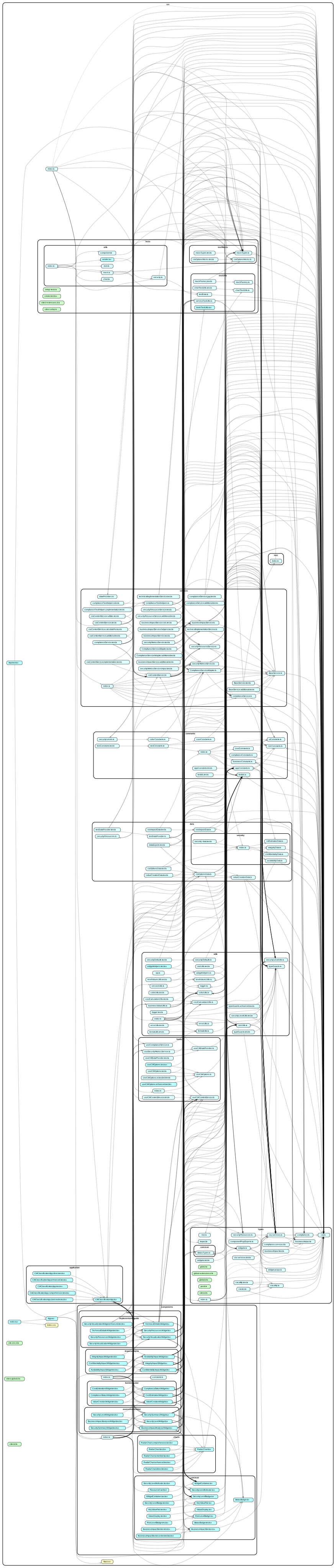
This diagram shows the relationship between different modules in the codebase:
The application itself is built with security as a priority:
- Role-Based Access Control - Granular permissions for different user roles
- Audit Logging - Comprehensive logging of all system activities
- Data Encryption - All sensitive data is encrypted at rest and in transit
- Secure Development - Built following secure coding practices and regular security testing
For comprehensive security documentation, visit the Security Documentation in our Documentation Portal.
We welcome contributions to our documentation. Please see the Contributing Guide for more information.
| Category | Technologies | Support Status | Latest Version | EOL Notes |
|---|---|---|---|---|
| Core Framework | React | Active | 19.x | No official EOL policy, supports N-2 versions |
| TypeScript | Active | 5.x | Older versions supported ~12 months | |
| Data Visualization | Chart.js | Active | 4.x | Community maintained, no formal EOL policy |
| UI/Styling | TailwindCSS | Active | 4.x | Major versions typically maintained for 1-2 years |
| PostCSS | Active | 8.x | Community maintained, no formal EOL policy | |
| Build Tools | Vite | Active | 6.x | Follows semver, minor versions supported until next minor |
| Testing | Vitest | Active | 3.x | Actively maintained with Vite compatibility |
| Cypress | Active | 14.x | Regular updates, typically supports N-1 version | |
| Testing Library | Active | 16.x | Community maintained, regular updates | |
| Development Utilities | Cross-env | Active | 7.x | Stable utility, minimal updates needed |
| Start-server-and-test | Active | 2.x | Utility package, stable API | |
| Runtime Requirements | Node.js | Required | ≥24.0.0 | Node 24 EOL: April 2028 |
| npm | Required | ≥11.0.0 | Follows Node.js support lifecycle |
The application offers several widgets to help manage and visualize security controls:
- SecuritySummaryWidget: Provides an overview of the current security posture
- SecurityLevelWidget: Allows selection of CIA security levels
- ComplianceStatusWidget: Shows compliance status with relevant frameworks
- CostEstimationWidget: Estimates implementation costs for security controls
- ValueCreationWidget: Shows business value created by security implementations
- AvailabilityImpactWidget: Details business impact of availability controls
- IntegrityImpactWidget: Details business impact of integrity controls
- ConfidentialityImpactWidget: Details business impact of confidentiality controls
- TechnicalDetailsWidget: Provides technical implementation details
- BusinessImpactAnalysisWidget: Analyzes business impact of security controls
- SecurityResourcesWidget: Shows resources relevant to security implementation
Runs the app in the development mode.
Open http://localhost:3000 to view it in the browser.
The page will reload if you make edits.
You will also see any lint errors in the console.
Builds the app for production to the build folder.
It correctly bundles React in production mode and optimizes the build for the best performance.
The build is minified and the filenames include the hashes.
Your app is ready to be deployed!
See the section about deployment for more information.
You can learn more in the Vite documentation.
To learn React, check out the React documentation.
The project implements comprehensive testing strategies to ensure reliability and quality, following our Secure Development Policy requirements.
The CIA Compliance Manager uses Vitest with React Testing Library for component testing. Our unit test approach follows these principles aligned with Secure Development Policy §4.1:
- Coverage Thresholds: Minimum 80% line coverage, 70% branch coverage
- Component isolation with mocked dependencies
- Constant-driven validation
- Test ID selection for reliable element selection
- Behavior verification focused on component functionality
- Automated execution on every commit and pull request
For detailed information on unit test structure, categories, examples, and best practices, see our Unit Test Plan.
End-to-end tests are implemented using Cypress following Secure Development Policy §4.2 and follow these core principles:
- Critical Path Coverage: All user journeys and business workflows tested
- User-centric testing with focus on key user flows
- Constant-driven selection for reliable element targeting
- Resilient testing with fallbacks and retry mechanisms
- Comprehensive coverage of both UI components and integrated functionality
- Browser compatibility validation across major platforms
For more information about E2E test organization, custom commands, test patterns, and best practices, see our E2E Test Plan.
The application includes a comprehensive performance testing framework per Secure Development Policy §8 to ensure optimal user experience:
- Measurement of key operations and interactions
- Performance baseline configuration per Classification Framework availability requirements
- Reporting and visualization tools
- Response time validation within E2E tests
For detailed information on performance testing methodology and tools, see our Performance Testing Documentation.
# Run unit tests
npm run test

# Run end-to-end tests
npm run cypress:run

# Open Cypress UI for interactive testing
npm run cypress:open

# Run performance tests
npm run cypress:run:perfWe're committed to making this project accessible, inclusive, and secure. Please review these important documents:
- Contributing Guidelines - How to contribute code and documentation
- Code of Conduct - Our standards for project participation
- Security Policy - How to report security vulnerabilities
- License - Project license details and terms
Explore our comprehensive documentation covering architecture, security, testing, and API references. All documentation is maintained according to our Secure Development Policy transparency requirements.
Complete system design with 20+ architectural diagrams including C4 models, security architecture, threat models, and future roadmaps.
| Document | Description | Links |
|---|---|---|
| C4 Architecture Models | System context, containers, components, and deployment views | Current • Future |
| Security Architecture | STRIDE threat analysis, attack trees, security patterns | Current • Future |
| Threat Model | Comprehensive threat analysis with STRIDE methodology | View Threat Model |
| Data Models | Entity relationships, data flows, classification | Current • Future |
| State Diagrams | System state transitions and workflows | Current • Future |
| Process Flowcharts | Assessment workflows and compliance processes | Current • Future |
| Concept Mindmaps | System structure and component relationships | Current • Future |
| SWOT Analysis | Strategic analysis and market positioning | Current • Future |
| CI/CD Workflows | DevOps pipelines and automation | Current • Future |
| Business Continuity | BCP planning and recovery strategies | Interactive • Markdown |
Security implementation details, compliance mappings, and ISMS integration aligned with our Classification Framework.
| Document | Description | Link |
|---|---|---|
| Control Mapping | Framework-to-ISMS-policy mappings (NIST, ISO, CIS) | View Mapping |
| ISMS Implementation | Detailed security control implementation (790 lines) | View Guide |
| Traceability Matrix | End-to-end control-to-evidence mapping (100+ controls) | View Matrix |
| CRA Assessment | EU Cyber Resilience Act compliance documentation | View Assessment |
| Security Policy | Vulnerability disclosure and security contacts | View Policy |
Comprehensive testing strategies following Secure Development Policy §4-5.
| Resource | Description | Links |
|---|---|---|
| Unit Tests | Vitest-based component and utility testing | Results • Plan |
| Test Coverage | Line, branch, and function coverage reports | Coverage Report |
| E2E Tests | Cypress end-to-end system validation | Report • Plan |
| Performance Tests | Benchmarks and optimization metrics | View Data • Documentation |
Technical reference documentation for developers and integrators.
| Resource | Description | Link |
|---|---|---|
| API Documentation | TypeDoc-generated API reference for all components | View API Docs |
| UML Diagrams | Class diagrams and component relationships | View Diagrams |
| Dependencies | Module dependency visualization | View Graph |
| Contributing Guide | How to contribute code and documentation | View Guide |

- 🔐 Information Security Policy - Overall security framework
- 🏷️ Classification Framework - Business impact and classification methodology
- 🛠️ Secure Development Policy - Development security standards
- 🎯 Threat Modeling Policy - STRIDE and MITRE ATT&CK framework
- ✅ Compliance Checklist - Multi-framework compliance tracking
- 🏗️ Security Architecture - Current security architecture with Mermaid diagrams
- 🔮 Future Security Architecture - Planned security enhancements
- 🎯 Threat Model - Comprehensive threat analysis
- 📋 Control Mapping - Framework-to-ISMS-policy mappings
- 📊 ISMS Implementation Guide - Detailed security control implementation
- 🔍 Traceability Matrix - End-to-end control-to-evidence mapping
- 🔍 Vulnerability Management - Security testing and remediation
- 🚨 Incident Response Plan - Security incident management
- 🔄 Business Continuity Plan - Business resilience framework
- 💾 Backup & Recovery Policy - Data protection procedures
- 📝 Unit Test Plan - Comprehensive unit testing strategy
- 🌐 E2E Test Plan - End-to-end testing methodology
- ⚡ Performance Testing - Performance benchmarks and optimization
- 🛡️ EU Cyber Resilience Act Assessment - CRA compliance documentation
- 🔐 Security Policy - Vulnerability disclosure and security contacts
- 📋 Privacy Policy - GDPR compliance framework
📋 Document Control:
✅ Approved by: James Pether Sörling, CEO
📤 Distribution: Public
🏷️ Classification:
📅 Effective Date: 2024-11-17
⏰ Next Review: 2025-02-17
🎯 Framework Compliance: 



